
What Is Skin Health? Understanding the Skin Barrier, Comfort & Healthy-Looking Skin

Your skin is constantly responding to the world around you but what is it actually trying to tell you?
Dryness, tightness, sensitivity and changes in texture can make us focus on what we see in the mirror. But healthy-looking skin begins with something deeper: how the skin functions as a living, protective barrier.
Skin is not simply a surface covering. It helps protect the body from the outside environment, limits excessive water loss, participates in immune defense and continually renews itself.
Understanding these basic functions makes it easier to understand why hydration, barrier care, nutrition, lifestyle and aging can all influence how skin looks and feels.
What Is Skin Health and Why Does the Skin Barrier Matter?
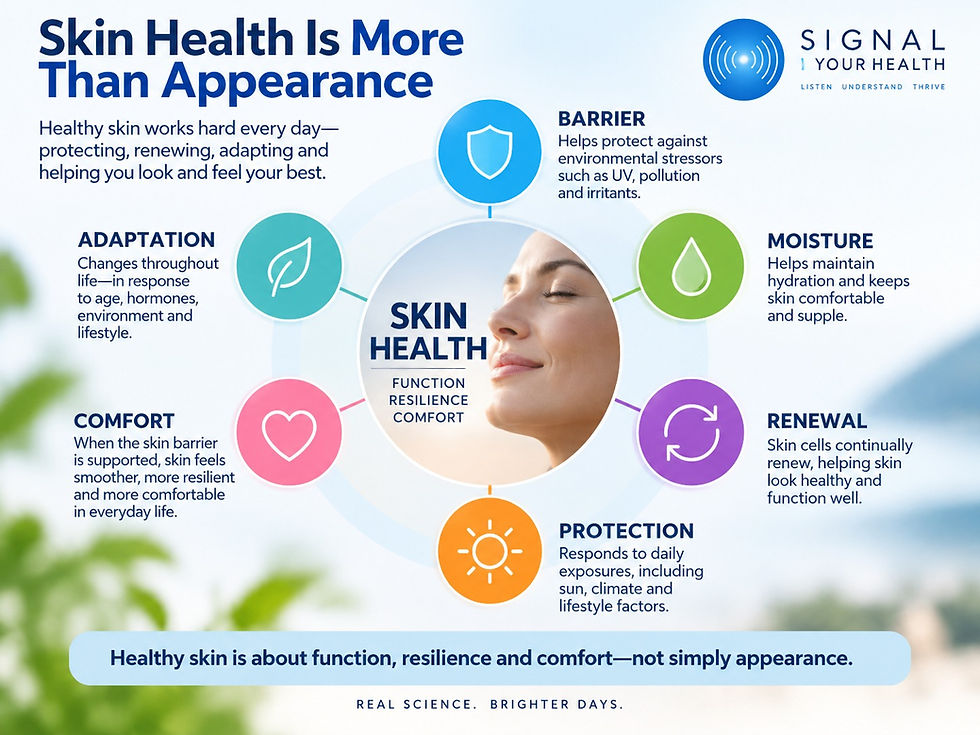
Skin health is about much more than how your skin looks.
Your skin is a living, active organ that forms the body's boundary with the outside world. Every day, it helps protect you from environmental exposures, limits excessive water loss, participates in immune defense and continually renews itself.
A useful way to think about healthy skin is a well-maintained protective wall. The outermost layer contains skin cells surrounded by lipids that help hold the barrier together. When this barrier is functioning well, it helps keep needed moisture in while limiting the entry of unwanted substances from the environment.
But skin is not static. It is constantly responding to what happens both outside and inside the body. Sun exposure, temperature, humidity and skincare practices can affect it from the outside, while age, nutrition, hormones and overall health can influence it from within.
This is why skin health is better understood as function + resilience + comfort, rather than simply the absence of wrinkles or blemishes.
Healthy skin generally has the ability to:
maintain an effective protective barrier
retain appropriate moisture
renew and repair itself
respond to environmental challenges
support normal immune functions
remain reasonably comfortable and resilient
And because skin changes throughout life, “healthy skin” does not necessarily mean young-looking skin. Lines, changes in texture and other visible signs of aging are normal.
The more useful question is:
How well is your skin protecting, renewing and adapting as you age?
Why Is the Skin Barrier So Important?
Think of your skin barrier as your body's outer security system. It has two important jobs at the same time: helping keep useful things, such as water, inside, while helping keep many potential irritants and environmental exposures outside.
The main barrier is found in the outermost part of the epidermis, called the stratum corneum. A common analogy is a brick wall: flattened skin cells called corneocytes act like the bricks, while lipids including ceramides, cholesterol and fatty acids; help form the mortar between them.

When this barrier is functioning effectively, it helps reduce excessive water loss and contributes to skin that feels hydrated, flexible and comfortable. It also forms an important first line of defense between the body and the surrounding environment.
When the barrier becomes disrupted, however, water can escape more easily and substances from the environment may penetrate more readily. Skin may then feel dry, tight, rough or uncomfortable.
Many everyday factors can influence the skin barrier, including frequent washing, harsh cleansers, low humidity, temperature changes, ultraviolet exposure and aging.
This is why caring for the barrier is an important part of maintaining skin health; not simply a cosmetic concern.
A simple way to remember it
Healthy skin barrier → retains moisture → provides protection → supports comfortable, resilient skin
The goal isn't to create a completely impenetrable barrier.
Healthy skin is a dynamic biological system that continually renews itself and responds to its environment.
And that raises the next question:
Why Does Skin Become Dry, Tight or Uncomfortable?
Dry or tight-feeling skin is often a sign that the skin is losing water faster than it can maintain comfortable hydration.
Water naturally moves from deeper layers of the skin toward the surface, where some eventually evaporates into the surrounding air.
This process is known as transepidermal water loss (TEWL). A healthy skin barrier helps regulate that water loss.
When the barrier is disrupted or its lipid structure changes, water can escape more readily. The result may be skin that feels dry, rough, tight, flaky or uncomfortable.
What can affect skin moisture and comfort?
Several factors can influence the skin barrier and its ability to retain moisture:
Age: Skin structure, lipid composition and natural moisturizing processes can change over time.
Climate: Cold weather, dry air and air-conditioning can increase moisture loss.
Cleansing: Frequent washing, hot water and harsh cleansers can remove some of the lipids that help support the barrier.
Sun exposure: Ultraviolet radiation can contribute to changes in skin structure and function over time.
Skincare products: Some ingredients or excessive use of exfoliating products may irritate or disrupt the barrier in susceptible skin.
Individual biology: Genetics, hormones and underlying skin conditions can also influence how skin retains moisture and responds to its environment.
One helpful analogy is to think of the skin barrier as a reservoir with a protective seal. Water will always move through the system, but when the seal is functioning well, water loss is better controlled. When that protective structure becomes compromised, moisture can escape more easily.
This is also why simply applying more water to dry skin doesn't necessarily solve the problem. Supporting skin comfort often involves helping the outer barrier retain moisture and maintain its normal structure.
Dryness also becomes more common for many people as they get older; which brings us to an important part of the healthy-aging story:
What Happens to Our Skin as We Age?
Skin aging is not simply about wrinkles.
Over time, changes occur across several layers and functions of the skin.
Cell renewal can slow, the skin's ability to retain moisture may change, and structural components that help provide strength and elasticity such as collagen and elastin also change with age.
The result can be skin that gradually becomes thinner, drier, less elastic and slower to recover from everyday stresses.
But there is an important distinction: skin aging has both intrinsic and extrinsic influences.
Intrinsic aging refers to biological changes that naturally occur with time. Genetics, hormones and changes in cellular processes all play a role.
Extrinsic aging is influenced by exposures accumulated throughout life. Ultraviolet radiation from the sun is particularly important, alongside factors such as smoking, pollution and other environmental and lifestyle influences.

Your skin carries a history
Think of skin as something like a living diary.
It doesn't record your life in words. Instead, its appearance and function reflect a combination of time, biology, environment and everyday habits.
Two people of the same age can therefore have quite different-looking skin.
Chronological age tells us how many years someone has lived, but it doesn't tell the complete story of how their skin has experienced those years.
This is why healthy skin aging should not be framed as trying to make older skin behave exactly like younger skin.
A more meaningful goal is to support the skin's ability to protect, retain moisture, maintain its structure and remain comfortable as it changes over time.
What is your skin trying to tell you?
A new line, a change in texture or increasing dryness doesn't automatically mean something is “wrong.” Some changes are simply part of normal aging.
Instead of asking:
“How do I stop my skin from aging?”
Signal Your Health encourages a different question:
“What does my changing skin need from me now?”
That shift from fighting age to understanding change can lead to more realistic decisions about skincare, sun protection, nutrition and everyday lifestyle.
And it brings us to the next part of the story:
How Does Everyday Lifestyle Influence Skin Health?
Skincare matters but skin health doesn't begin and end with what you put on your skin.
Skin is part of the body, so it is influenced by many of the same everyday factors that affect health elsewhere.
Nutrition, sleep, physical activity, stress, smoking and sun exposure can all contribute to the environment in which skin cells function, renew and respond.
Think from the inside out and the outside in
A useful way to understand skin health is as a two-way relationship.
From the outside in, your skin encounters sunlight, temperature changes, humidity, pollution, cleansing products and skincare ingredients.
From the inside out, skin depends on nutrients, circulation and normal biological processes that support its structure, renewal and function.
Neither side works in isolation.
For example, a good moisturizer can help reduce water loss from the skin's surface but it cannot replace adequate nutrition. Likewise, a nutritious diet does not remove the need to protect skin from excessive ultraviolet exposure.
Everyday habits that can support healthy skin
Protect your skin from excessive UV exposure.
Ultraviolet radiation contributes to premature skin aging and can damage cellular components. Shade, appropriate clothing and sunscreen are important parts of protecting exposed skin.
Eat for overall health, not a single “skin superfood.”
Skin requires proteins, essential fatty acids, vitamins, minerals and other nutrients as part of normal tissue maintenance. A varied, nutrient-dense diet is generally more meaningful than relying on one fashionable ingredient.
Pay attention to sleep.
Sleep is part of the body's broader cycle of recovery and regulation. Rather than thinking of sleep as a beauty treatment, consider it part of the biological environment in which your skin and the rest of your body functions.
Keep moving.
Regular physical activity supports cardiovascular and metabolic health. These systems are interconnected with overall healthy aging, even though exercise itself should not be presented as a direct treatment for skin aging.
Avoid smoking.
Smoking is associated with premature skin aging as well as much broader health risks.
Manage the environment around your skin.
Very hot showers, harsh cleansing, excessive exfoliation and prolonged exposure to dry environments can make already-dry or sensitive skin feel less comfortable.

There is no single switch for healthy skin
This is where the idea of Signal Your Health becomes particularly relevant.
Your skin doesn't experience nutrition, sleep, aging, sunlight and skincare as completely separate categories. They become part of the same biological environment.
So instead of searching for one product, ingredient or habit that will “fix” skin aging, a better question may be:
What combination of everyday choices is helping or challenging my skin's ability to protect, renew and adapt?
That brings us naturally to what we actually put on the skin:
Can Skincare Support the Skin Barrier?
Yes but good skincare is not necessarily about using more products.
It is about understanding what your skin barrier is designed to do and choosing care that supports those functions.
At its simplest, a skincare routine can help with three basic needs: cleansing without unnecessary disruption, maintaining moisture and protecting skin from environmental exposure.
Cleansing: clean doesn't have to mean stripped
Cleansing removes dirt, excess oil, sweat, sunscreen and other substances that accumulate on the skin.
But that familiar “squeaky-clean” feeling isn't necessarily a sign of healthier skin.
Frequent washing, very hot water or harsh cleansers can remove some of the surface lipids that contribute to the skin barrier.
For skin that tends to feel dry or tight, gentler cleansing may sometimes be more appropriate than stronger cleansing.
Moisturising: helping the skin hold on to water
A moisturizer doesn't simply “add water” to the skin.
Depending on its formulation, it may contain ingredients that attract water, soften the outer skin layers or form a surface layer that helps reduce excessive water loss.
Remember our earlier brick-wall analogy?
Moisturising can be thought of as helping maintain the environment around those bricks and mortar so the barrier can continue doing its job effectively.
Protection: prevention matters too
Skincare isn't only about responding to visible changes after they appear.
Protecting skin from excessive ultraviolet exposure is particularly important.
Regular sun protection can help reduce UV-related skin damage and photoaging while also reducing the risk of skin cancer.
More isn't always better
Modern skincare can involve long routines containing cleansers, toners, serums, exfoliants, masks, oils and creams.
But adding products doesn't automatically produce healthier skin.
Some people tolerate complex routines well; others find that frequent exfoliation, multiple active ingredients or constantly changing products leave their skin feeling irritated or uncomfortable.
The useful question is therefore not:
“How many products should I use?”
It is:
“What does my skin actually need?”
That might mean paying attention to how your skin feels after cleansing, whether it remains comfortably hydrated, how it responds to particular products and whether your routine is appropriate for your environment and stage of life.
From skincare products to a skincare strategy
This distinction is central to the Signal Your Health approach.
Instead of beginning with a product and looking for a problem it might solve, begin with understanding the skin.
Understand the barrier → notice what is changing → consider possible influences → choose appropriate care.
That makes skincare less about chasing every new ingredient or trend and more about making informed choices that support healthy-looking, comfortable and resilient skin.
And once we understand that foundation, we can ask a more practical question:
How Do You Build a Skin Health Routine That Works for You?
There is no single skincare routine that is right for everyone.
Skin changes with age, environment, lifestyle, sun exposure and individual biology.
A routine that feels comfortable in one stage of life—or even one climate—may need to change later.
Rather than beginning with a long list of products, start with three questions:
What does my skin need to be protected from?
What does my skin need to maintain?
What is my skin telling me through changes in comfort, dryness or appearance?
Start with the foundations
For many people, a sensible skin-health routine can be built around a few basic principles.
1. Cleanse appropriately
The purpose of cleansing is to remove unwanted material without unnecessarily disrupting the skin barrier. How often and how strongly you cleanse may depend on your skin, activity level, environment and the other products you use.
2. Support moisture and comfort
If your skin frequently feels dry or tight, consider whether your routine is helping it retain moisture. Moisturizers and other appropriately formulated skincare products can help support hydration and reduce water loss from the skin's surface.
3. Protect against excessive UV exposure
Sun protection deserves a permanent place in a skin-health strategy. Sunscreen, shade and protective clothing can help reduce cumulative UV exposure and photoaging.
4. Introduce additional products with a purpose
Serums, toners, exfoliants and other products can have a place in a routine—but ask why you are adding them.
Instead of thinking:
“What else should I put on my skin?”
try asking:
“What am I trying to support?”
That simple change can make skincare much easier to understand.
Watch for signals, not perfection
Your skin provides feedback.
Does it feel comfortable after cleansing?
Does it become unusually tight later in the day?
Does a new product leave it feeling irritated?
Does your routine still work when the weather, travel schedule or season changes?
These signals don't diagnose what is happening beneath the surface, but they can help you recognize when your routine may need reconsideration.
Persistent, severe or unexplained changes particularly rashes, sores that don't heal, changing moles or significant irritation should be assessed by an appropriate healthcare professional rather than treated as simply a skincare problem.
Your routine can evolve with you
Perhaps the most important idea is that a skincare routine doesn't need to remain fixed for life.
As skin changes with age and circumstances, the goal is not necessarily to keep adding products. It is to keep asking whether the products and habits you use still make sense for your skin today.
At Signal Your Health, we think of this as moving from a product-first approach to an understanding-first approach:
Notice → Understand → Support → Reassess
Your skin changes. Your routine can change with it.
Where Do RENU28, REDOXGold, ASEA Radiance and RENUAdvanced Fit?
Once you understand the fundamentals of skin health, skincare products become easier to evaluate. Instead of asking “Which product is best?”, a more useful question is:
“What role does this product play in my overall skin-health routine?”
ASEA's Skin & Personal Care range includes products designed for different parts of that routine. They should not be viewed as substitutes for basics such as appropriate cleansing, moisturising, sun protection and professional care when needed.
RENU28 a topical skin-support product
RENU28 is a topical gel designed to be applied directly to the skin. Within a routine, it can be thought of as an additional skin-care step rather than a cleanser or conventional moisturizer.
ASEA has also conducted clinical skin assessments of RENU28, including measurements related to the appearance and characteristics of the skin.
When discussing those studies, it is important to distinguish measured study results from outcomes that every individual should expect.
Think of its role as: whole body topical skin care and support.
REDOXGold for targeted topical care
REDOXGold is another topical product within ASEA's skin-care range and can be incorporated into targeted and specific areas of a personal skin comfort routine.
As with any topical product, individual experience can vary. Its role should be considered alongside not instead of the fundamentals of maintaining and protecting skin health and comfort.
Think of its role as: a targeted step within a broader skin-care routine.
ASEA Radiance your beauty nutrition from within
ASEA Radiance approaches the skin conversation differently because it is consumed rather than applied to the skin.
This provides a useful reminder that skin is not isolated from the rest of the body.
Nutrition provides the building blocks required for normal biological functions
throughout the body, including the skin.
However, an ingestible beauty product should not be viewed as a replacement for a balanced diet, appropriate skincare or sun protection.
Think of its role as: nutritional support within a broader approach to healthy-looking skin.
RENUAdvanced a structured skincare system
RENUAdvanced provides a more traditional multi-step skincare approach, with products designed to work together as a routine.
Rather than adding individual products without a clear purpose, a system can provide structure around steps such as cleansing, toning, serum application and moisturising.
The important question remains the same: does the routine suit your skin, your environment and what you are trying to support?
Think of its role as: a structured daily skincare routine.
Products are tools not the whole strategy
This is where the distinction we have been making throughout this article becomes important.
Healthy-looking skin is influenced by skin-barrier function, age, environmental exposure, lifestyle, nutrition and skincare. No individual cosmetic or nutritional product represents that entire picture.
A better approach is:
Understand your skin → establish the fundamentals → identify what you want to support → choose products appropriately → observe how your skin responds.
That is also why Signal Your Health separates education from product exploration.
If you would like to learn more about these products, how they differ and the available research behind them, continue to our dedicated Skin Health & Comfort guide.
Sources & Further Reading
This article is for general educational purposes. The following scientific and public-health sources provide further reading on skin-barrier function, skin aging, ultraviolet exposure, nutrition and lifestyle.
National Institute on Aging (NIH) : Skin Care and Aging
An overview of how skin changes with age, including dryness, thinning, sun exposure and everyday skin care. Read:
Skin Barrier Function & Transepidermal Water Loss (TEWL)
Peer-reviewed scientific literature explaining the skin barrier, stratum corneum and the movement of water through the skin.
World Health Organization : Ultraviolet Radiation
Public-health information about ultraviolet radiation, its effects on the skin and approaches to reducing excessive UV exposure.
Lifestyle Factors & Skin Aging
A peer-reviewed review examining how factors including nutrition, physical activity, sleep and stress may relate to skin aging.
Dietary Interventions & Skin Aging
A systematic review and meta-analysis examining research on dietary interventions and measures related to skin aging.
Comments